
Welcome person who wants to share something with others.
I created this guide because I disliked pretty much every resource I could find about dissemination. I think they teach you the wrong way to do things simply because it sounds right. But sounding right and being right are not the same thing.
Everybody is welcome here, but I’m assuming you’re probably some kind of academic, researcher, evaluator, scientist, public health worker, or some other type of highly educated person. Because most other people don’t use the word dissemination, they just talk about sharing stuff, comms, or marketing.
Prefer to peruse my method gallery than read this guide? [Click Here]
Trust me, I’m a cartoonist.
Most of these kinds of guides were written by groups of people with PhDs and grant money. I, on the other hand, am just an indy consultant with no university affiliation and zero funding.
Now I do have an MA and have also spent over 20 years as a researcher and evaluator. The first half of my career involved lots of data collection grunt work, analyzing stuff in SPSS and Excel, and helping write boring reports that nobody will ever read.
But over the last 15 years I’ve also drawn thousands of comics and published hundreds of blog posts. I’ve developed websites, managed online communities, built online courses, organized virtual summits, led many webinars, created infographics, designed dashboards, edited videos, and all sorts of other stuff you might just call comms work or marketing.
In other words, I have a weird mixed background that gives me a unique perspective on how to do a good job of sharing stuff with people in the digital age.
There is a huge disconnect between how research and evaluation is shared and how everybody else shares their work. It’s time to evolve.
Five basic rules before we begin.
Rule #1: Everybody is overwhelmed.
This is your boss, the people you think might be interested in what you have to share, the people who are not interested but you think should be interested in your work, etc. This also includes me and you. Humans have never had as much access to information as they do right now, and it is messing with our brains.
Rule #2: No audience is a monolith.
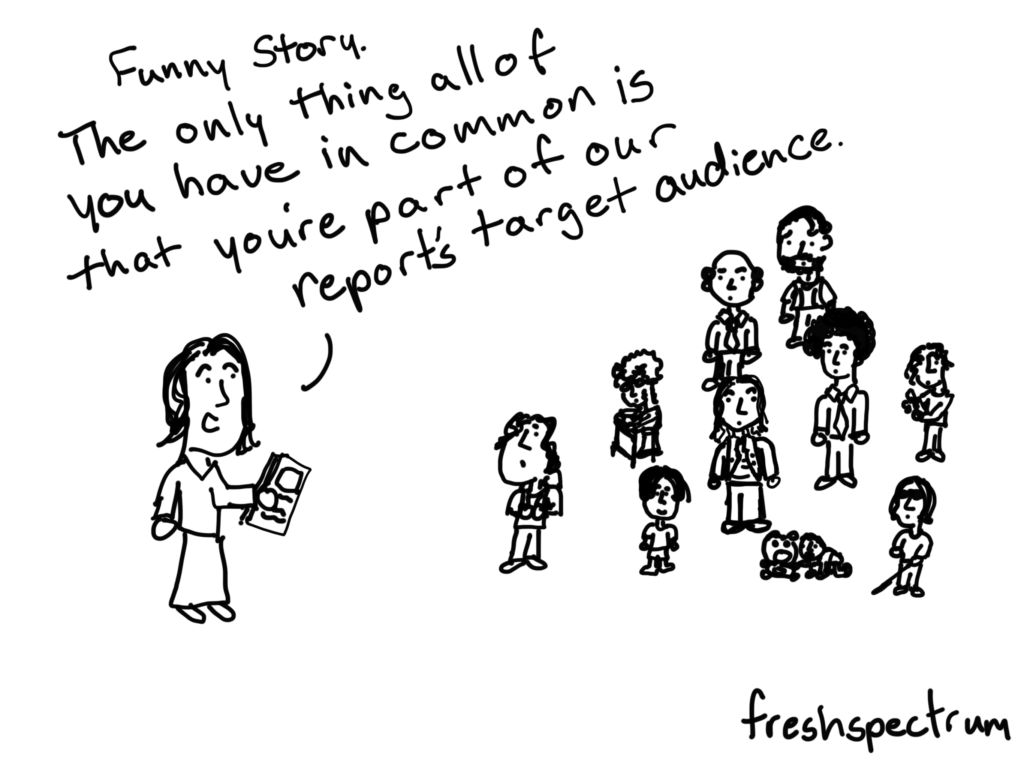
There is no one perfect way to disseminate anything because every person we are attempting to reach is unique. But we still should group people together based on similar characteristics because we don’t have unlimited time and money.
Rule #3: The status quo predates the internet.
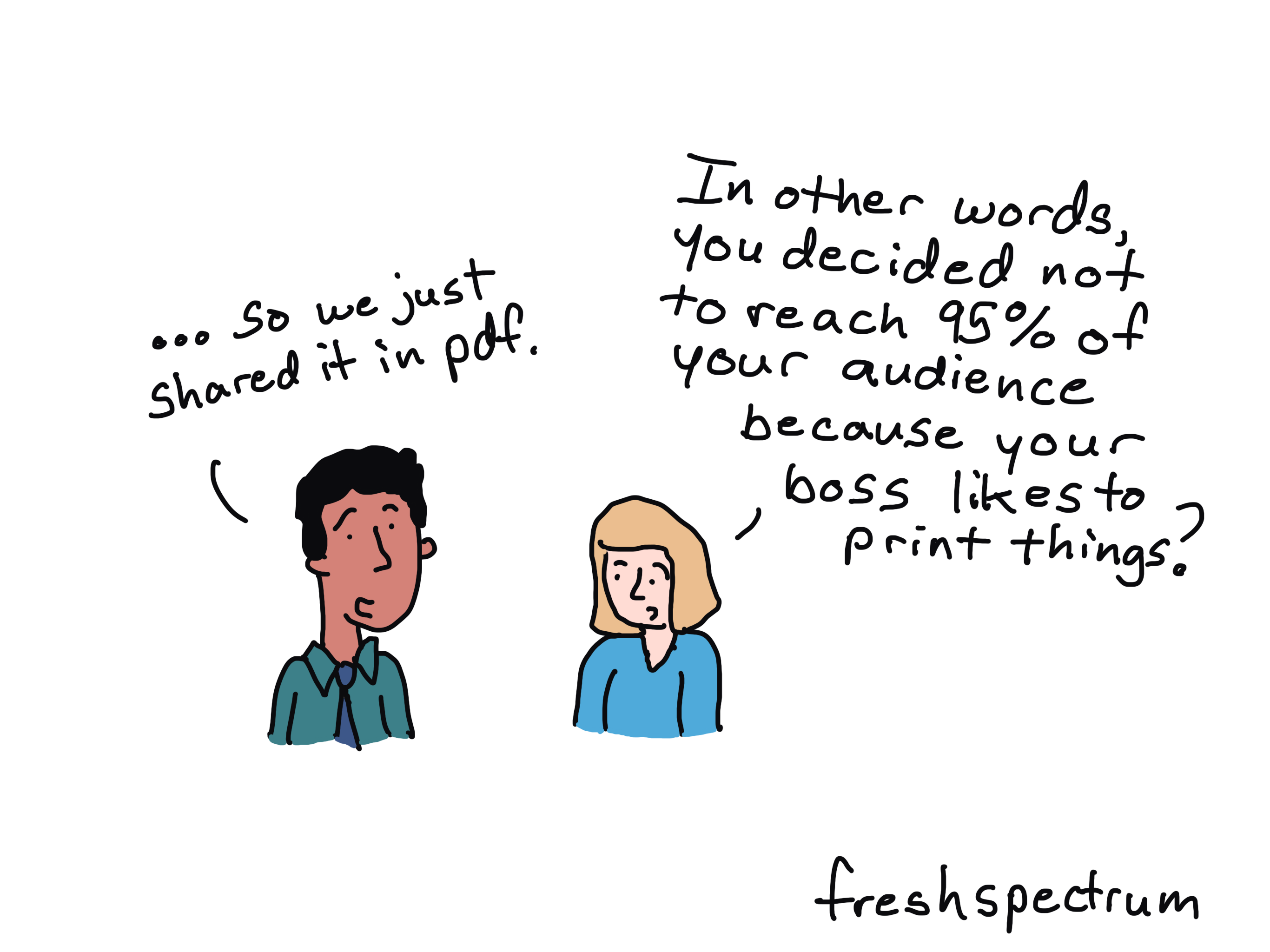
The way most orgs disseminate right now mimics the way organizations disseminated before the web. And the most used digital format, the PDF, came out in 1993, before Social Media, before YouTube, before Wikipedia, and even before Google.
Rule #4: Dissemination is work.
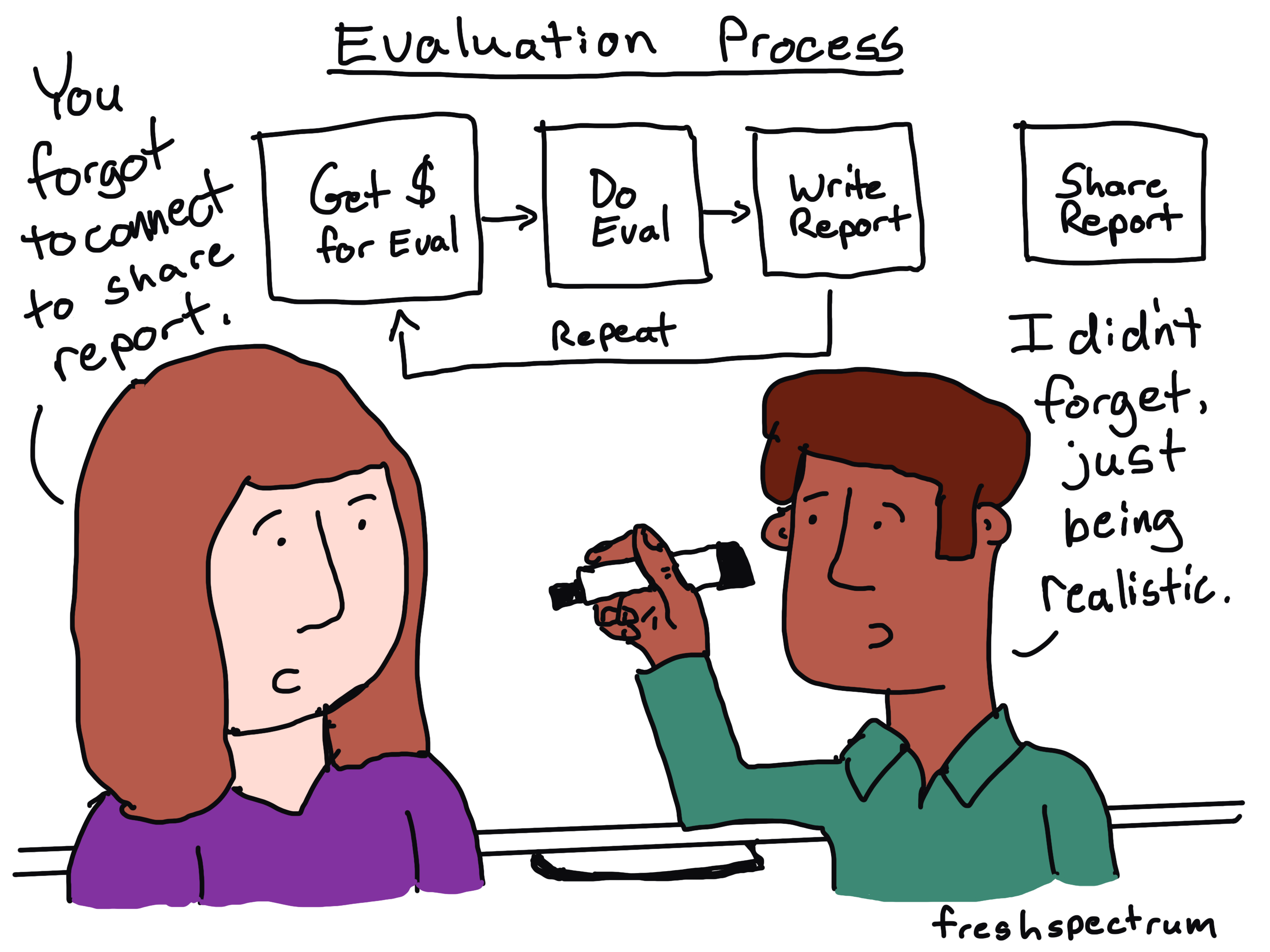
Most orgs just assume dissemination happens at the end of the research/evaluation/resource development process. Or people assume that the comms team has it under control. But often it’s neither. Effective dissemination only happens when there is intent, someone with the skills necessary to follow through, and an actual dissemination budget.
Rule #5: Every choice you make decides who you reach and who you exclude.
Most exclusion is unintentional but it’s still an outcome of our choices. The format you pick, the platform you post to, the reading level you write at — each one opens a door for some people and closes it for others.
My Four Phase Dissemination Framework.
I’m not going to give you a one-size-fits-all dissemination strategy. Instead, I’m going to give you a bunch of useful methods grouped together into four different phases. Your job will be to string together a set of methods based on your own audiences, insights, experience, budget, and context. That set of methods becomes your dissemination strategy.
The four phases are really quite simple: Plan, Design, Communicate, Evaluate.
Phase 1: Plan
For the last decade I’ve worked mostly in program evaluation. One of the first things evaluators do when working with a new project is to figure out how the project is supposed to work. We don’t tend to take the same logic into our dissemination efforts. Thinking about how dissemination is supposed to work can really make a lot of your reporting decisions easier to make.
First things first, dissemination is NOT actually about sharing reports.
It’s about sharing insights.
Most dissemination advice treats “the report” like it’s a culmination of all of our work. But most reports are just a hand-picked collection of insights. Some are useful for some audiences and some are useful for others. By treating the report like it’s THE representation of our work, we miss a huge opportunity to better shape our efforts.
For example, it is entirely possible that your dissemination efforts would be better served by having a simple direct conversation with a handful of the right people than by creating the fanciest of fancy reports.
Treat your dissemination strategy as a way to share insights (the actual product of your work) with the audiences that can use them.
Plan Methods.
- Five Audience Framework
- Theory of Use
- Dissemination Budget
- Single Source of Truth
- Audience Needs Assessment
- Product Bundle
- Dissemination Plan
Phase 2: Design
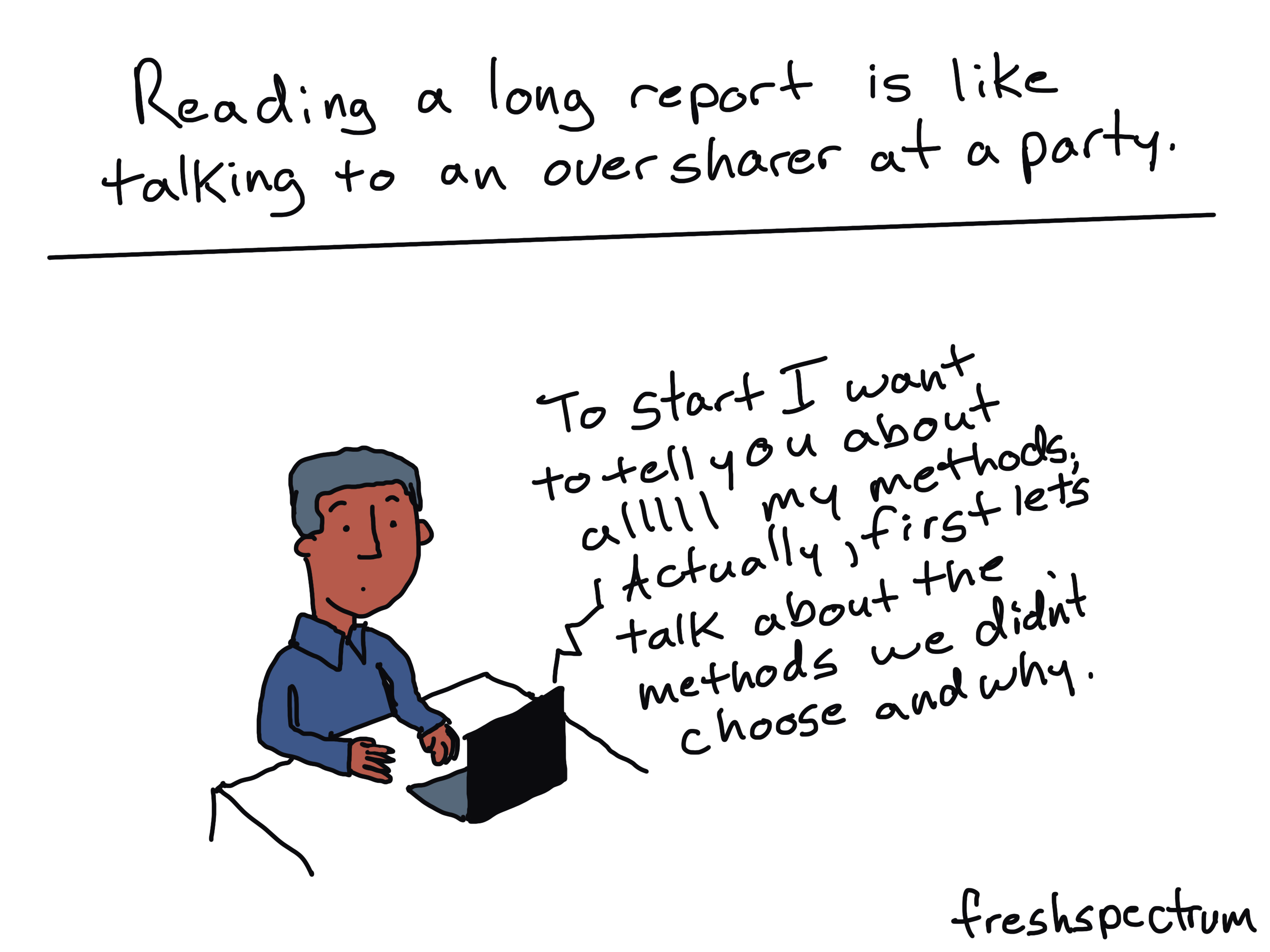
The biggest design mistake I see research and evaluation teams make is in putting all of their reporting time and effort into building a single technical report. It’s better to take some of that effort and apply it to the creation of different products.
I’ve found through experience that it takes just about as much time and effort to create a collection of infographics, simple slide decks, blog posts, and even short videos as it does to completely redesign a long technical report. Which activity do you think will better serve your audiences?
Design Methods.
- Simple 1 Pager
- Simple 3 Pager
- 25 Page Slidedoc
- Micrographic
- Social Media Carousel
- Single Panel Comics
- HTML Executive Summary Landing Page
- HTML Article Style Report
Phase 3: Communicate
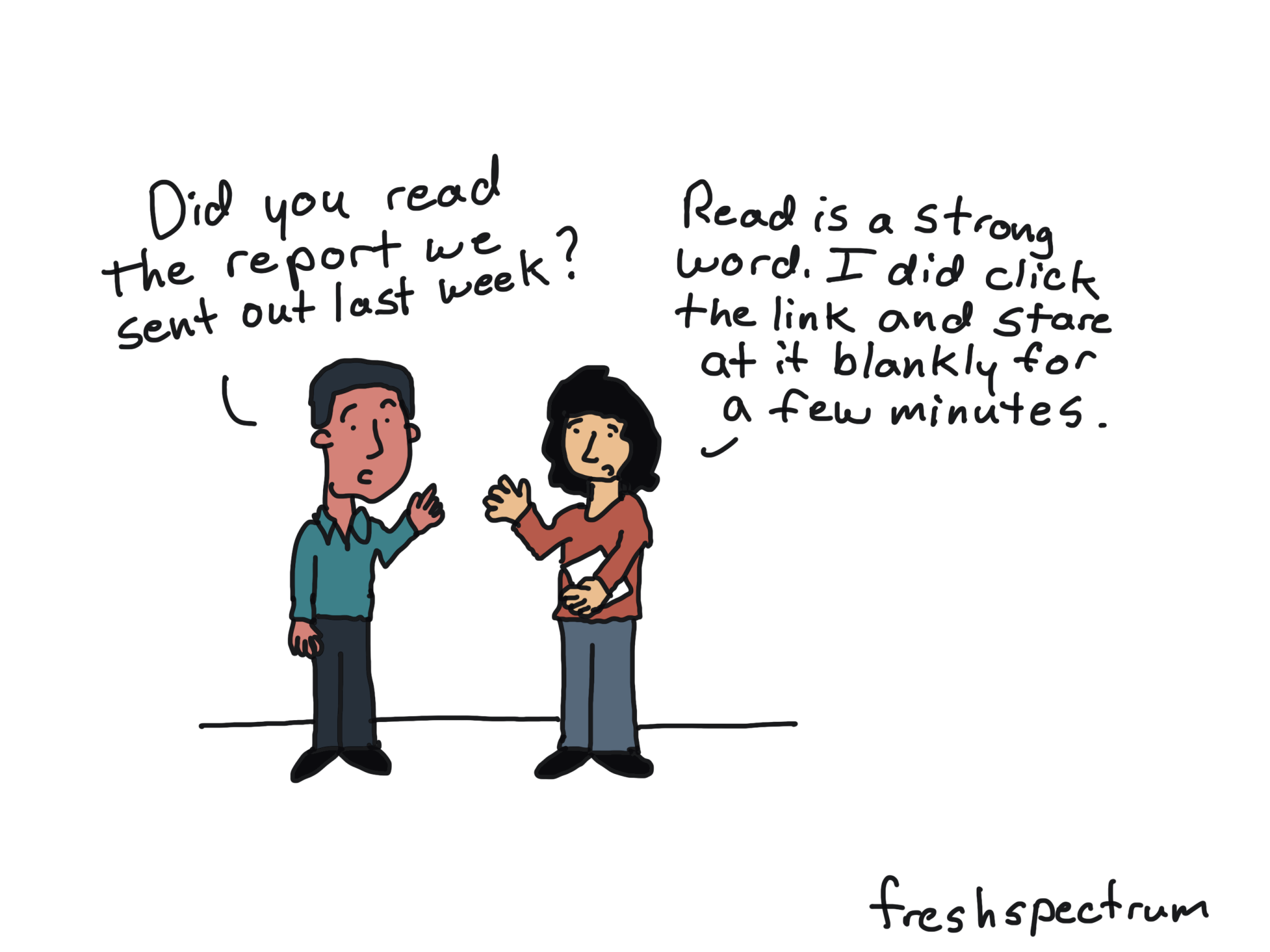
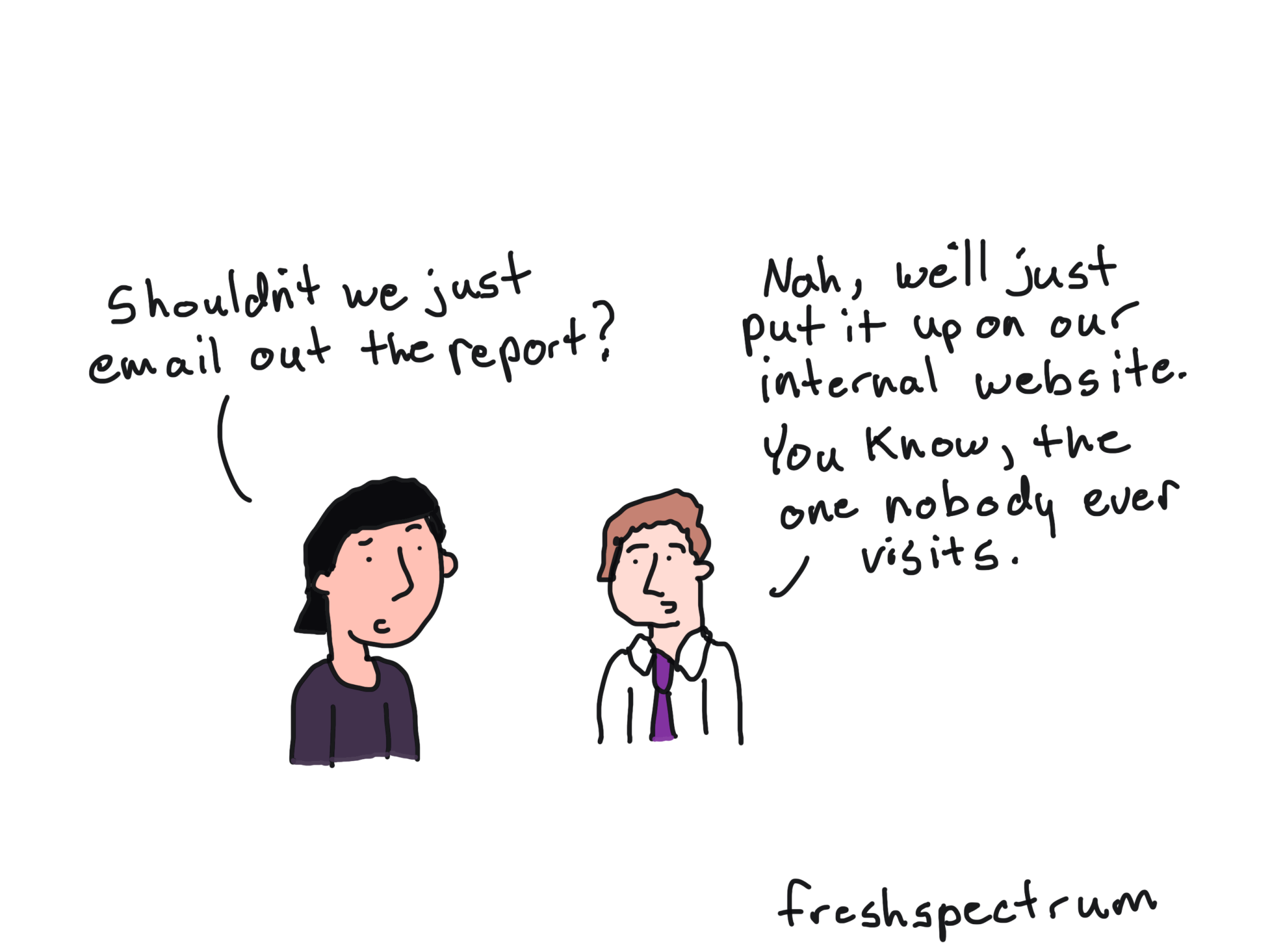
There is a kind of magical thinking involved in a lot of reporting activities. The belief is that if you create a report, and post that report to your organization’s resource page, it counts as reporting. That if it’s important, people will find it.
That wasn’t true 20 years ago, and it’s definitely not true today. People are so overwhelmed with information that even the best stuff is easy to miss. It’s why the best insights don’t just need to be valuable, they need to have a champion. Someone willing to put in the extra effort to deliver those insights to the people who can use them.
There is also this belief sometimes, especially in larger organizations, that sharing our work is somebody else’s job. Maybe you have a really good communications team or marketing team. But rarely do they care as much about your work as you do. And sharing your work is often just a very small part of their overall role.
Communicate Methods.
- Audience Building
- Audience Magnets
- Audience Borrowing
- Social Objects
- Newsletter Writing
- Search Strategy
- LinkedIn Strategy
- YouTube Strategy
- Webinar Strategy
- Content Calendar
Phase 4: Evaluate
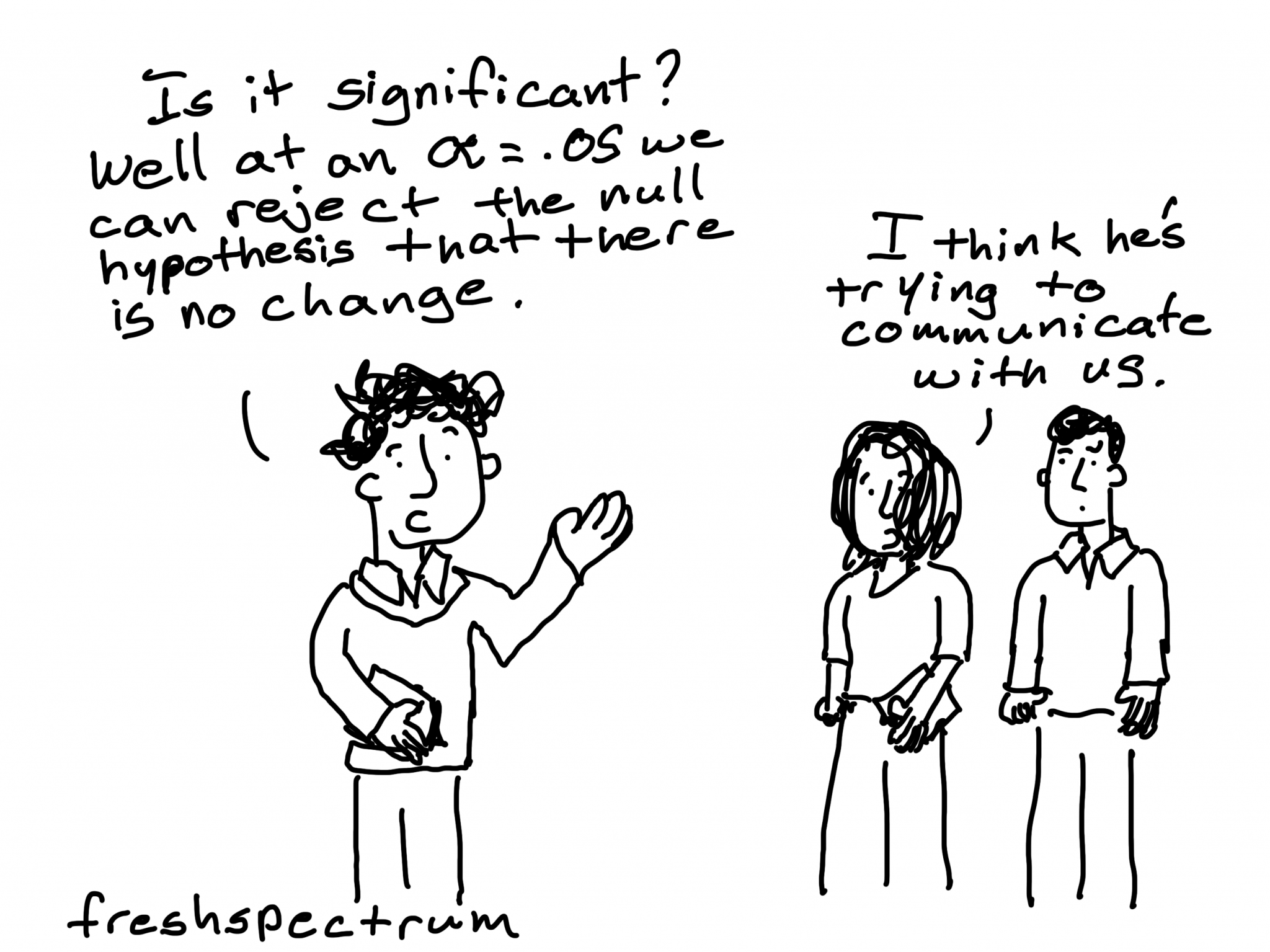
The best dissemination plans are the easiest to evaluate. Evaluation is just checking on how well your strategy is working. And how you might be able to make it better.
Status quo reporting methods (so many PDFs!) could only provide you with limited data. Usually you just knew how often your resource was downloaded. Analytics for HTML reports, social media content, video content, and newsletter content is far richer and can give you a more detailed view of the user experience.
Evaluate Methods.
- Google Analytics
- Search Analytics
- Social Media Analytics
- Newsletter Analytics
- UX Evaluation
- Page Recording
- Readability Testing

Some words of encouragement.
Our work needs champions for it to spread.
Right now there is a gap between the technical products developed by research and evaluation teams and the sharing done by most org comms teams. Because dissemination usually happens at the end of a project, the expert team behind the work is often ready to move onto the next thing. The comms team is the face of an organization, responsible for building and serving the org’s audience.
There is rarely sufficient budget or time dedicated to dissemination budgets. Usually it’s tied in directly with technical report writing, technical report copyediting, and technical report graphic design. By the time all of that is done, the budget is drained and the contract is in its last days. At the moment it should ramp up, it fizzles out.
So we get what we pay for. Millions of dollars put into research and evaluation that is likely archived but never adequately shared.
For the people who really care, it can be discouraging. That’s me, and I’m guessing you because you made it this far. But while the effort you put in during a time when everyone else is checking out is often thankless, it’s not futile. Little bits of process improvement here and there can have a huge impact on who gets to see our work and who gets excluded.
I believe in you. Now go share some stuff.